Actual Crown Inspection · Kansas City, MO · August 24, 2026
Field Record274Original Photographs In This Inspection Archive
Prove It Or Lose It In 2027!
A Compelling Record Answers The Hard Questions.
What changed? When was it observed? What supports the explanation? What will a repair actually disturb?
Crown’s reports organize those answers into photographs, chronology, test records and construction findings that another reviewer can follow. Every report is a record of facts at a specific date and time, whether storm damage is found or not. We work with owners who value a complete record and are willing to participate in documenting their property.
“2027” identifies Crown’s evidence campaign. It is not a new law or claim deadline. Documentation supports review; it does not guarantee coverage or payment.
01 / From A File To A Finding
The Method Behind The Report.
Adapted from Crown’s “Prove It or Lose It” evidence framework and completed field reports. Every step should leave a traceable record.
01
Preserve
Keep original photos, video, filenames and available capture metadata. Record who supplied each item.
02
Classify
Locate the observation. Distinguish weather-related indications from wear, blistering, installation and mechanical conditions.
03
Corroborate
Compare the reported timeline with prior records, collateral observations and cited public weather data.
04
Test
Where appropriate and authorized, document material access, seal condition and effects on adjacent shingles.
05
Explain
Connect supported findings to the construction scope. Identify missing evidence and the next qualified review.
Nearby weather reports help investigate a reported loss. They do not measure hail at a specific parcel or prove that its roof was damaged. Keep the owner’s chronology and the weather evidence distinct.
02 / Inside Actual Crown Reports
See What Better Documentation Looks Like.
These are original Crown photographs and public report excerpts. Each example answers a different question.
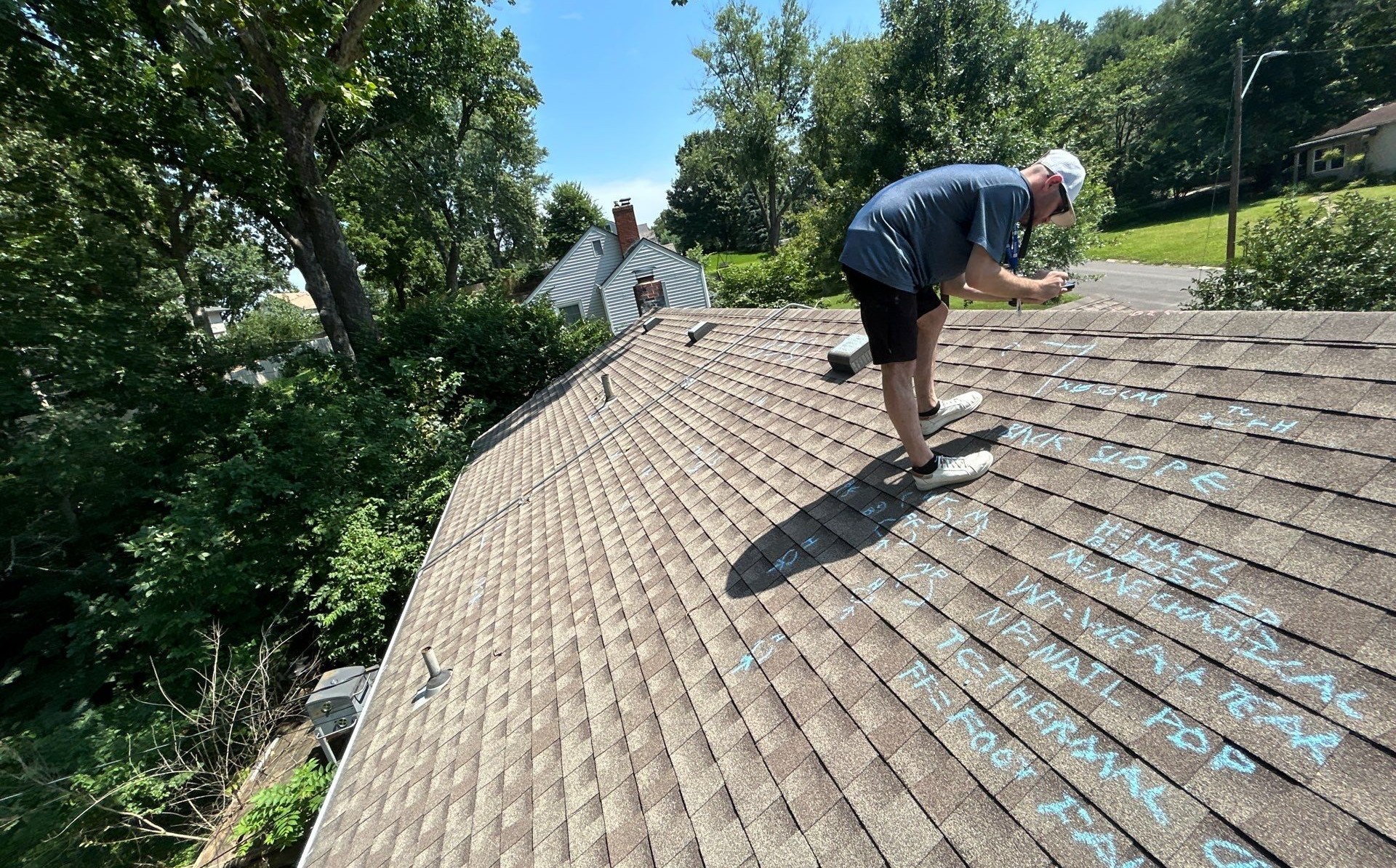
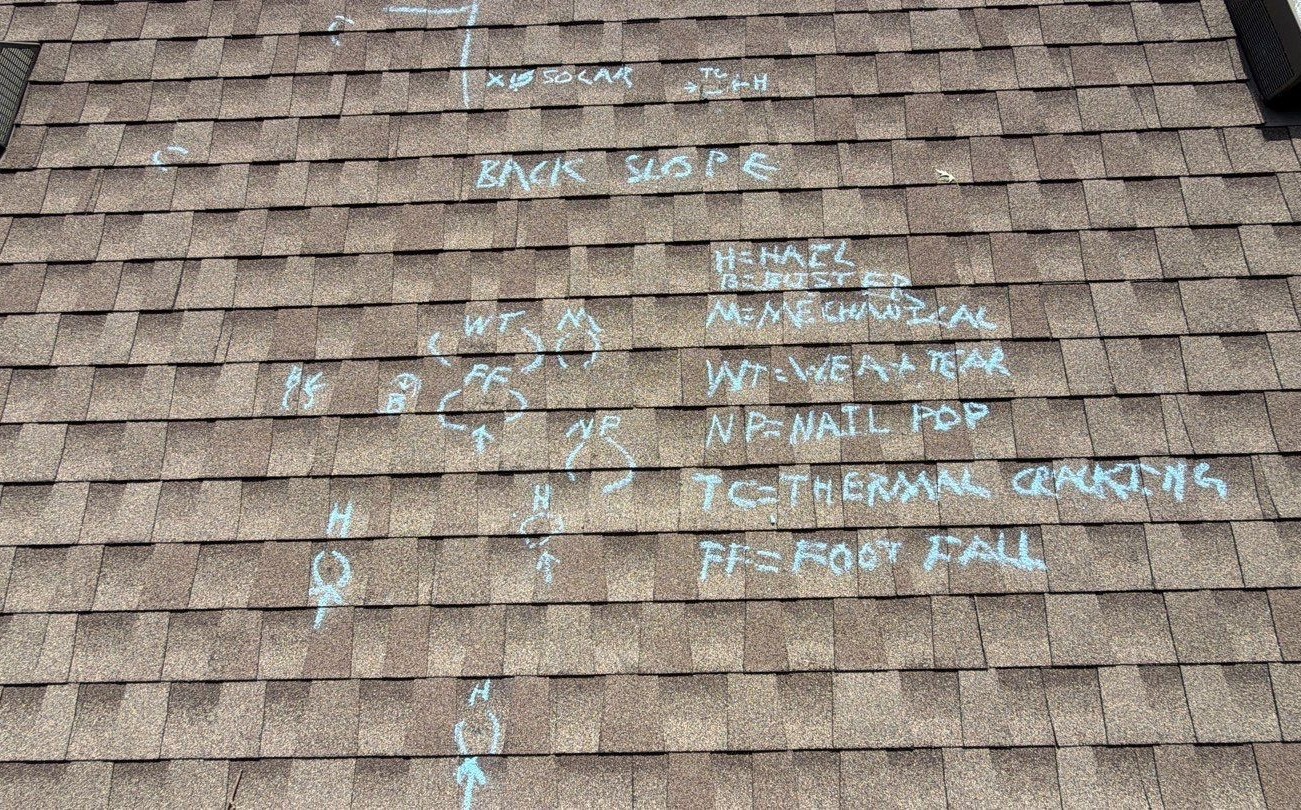
Examine The Original ↗Kansas City roofing + solar report · p. 7 · original inspection markings preserved.
Exhibit A / Classify The Condition
Every Mark Has A Meaning.
The inspector’s seven-category legend separates hail classifications from blistering, mechanical effects, wear, nail pops, thermal cracking and foot fall. Those distinctions guide the investigation.
HHailBBlisterMMechanicalWTWear & TearNPNail PopTCThermal CrackingFFFoot Fall
A chalk mark records a field classification. Close-range evidence, context and testing support the finding.
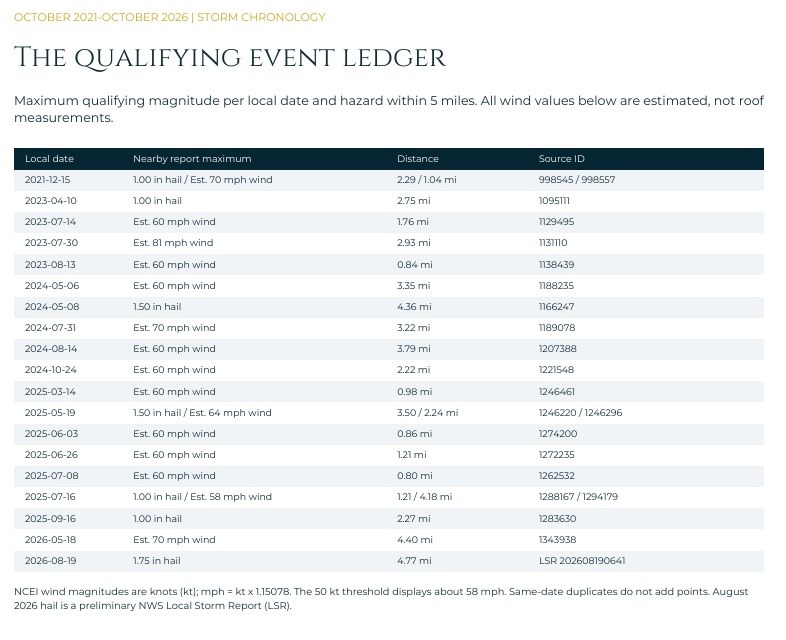
The Kansas City residential report records nearby events with distances and source IDs. The property history, observed conditions and unresolved questions stay visible alongside that weather chronology.
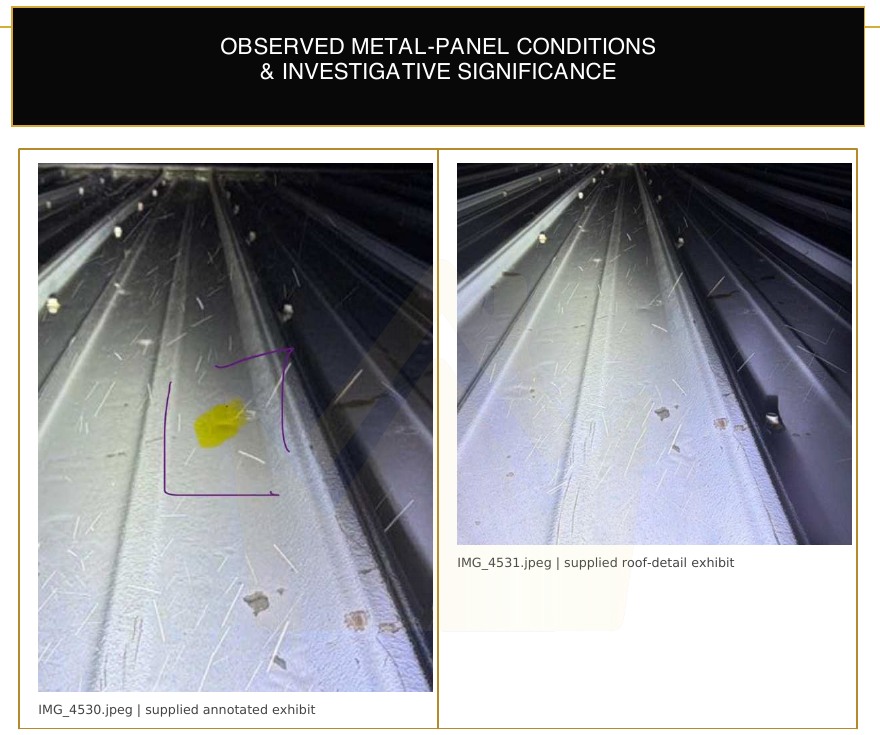
The Westbridge example pairs a marked detail with a wider view and original image IDs. It distinguishes visible conditions from causes that need further investigation.
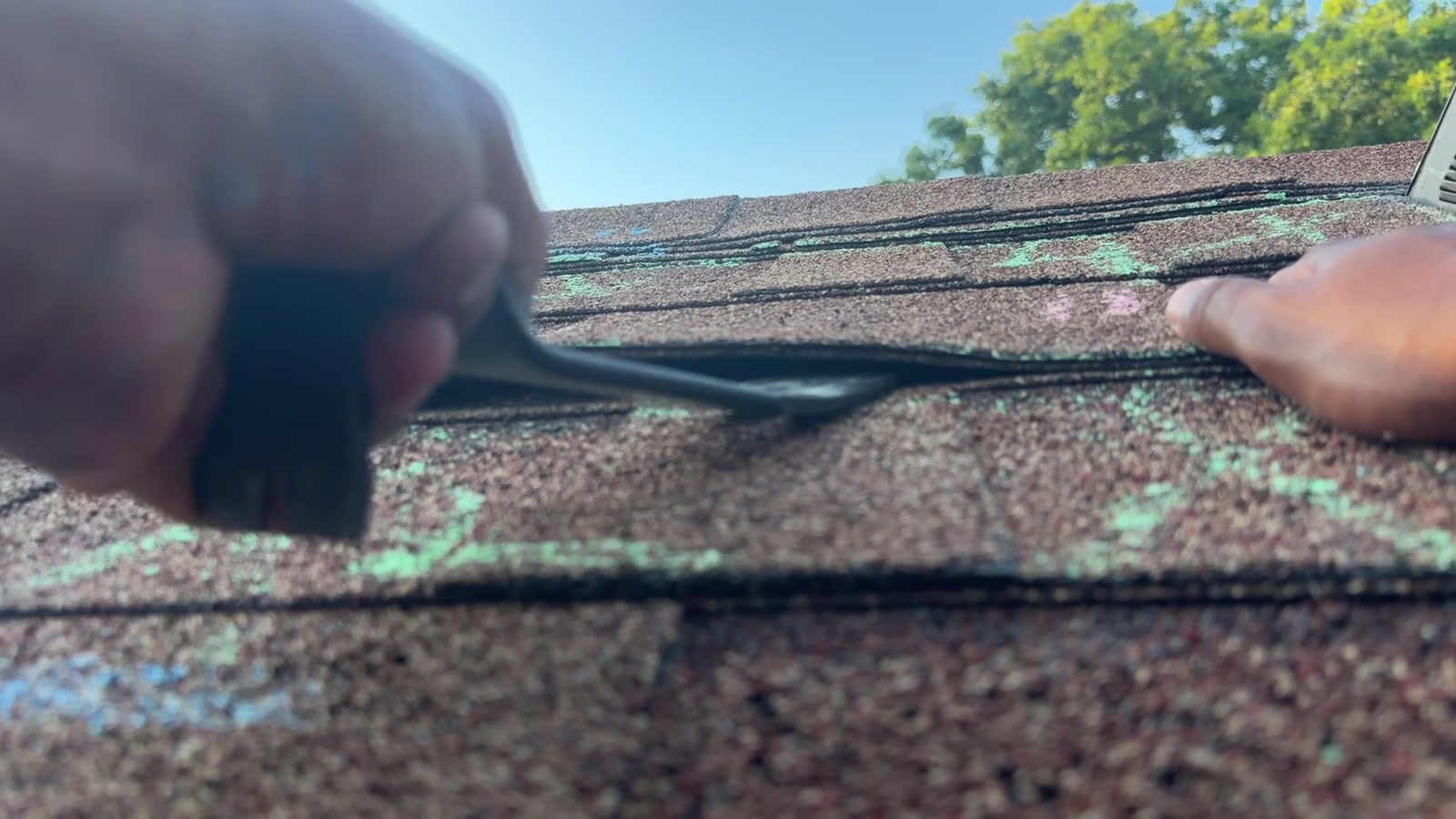
A separate Wichita test records what happens when adjoining shingle courses are lifted to reach a component. Timestamped frames connect the action to the material’s response.
Source video V4 · 01:40 · July 31, 2026. A case-specific test, not a prediction for every roof.
Proactive Ownership / Before Renewal
The 10–15 Year Coverage Cliff.
A useful warning window. A question to resolve before a loss.
Roof age can affect replacement-cost eligibility and depreciation. At renewal, ask your agent to confirm your roof settlement terms in writing. At the property, establish a dated condition record.
ESTABLISH
Your Baseline
Installation date, materials, photographs and repair history.
10–15 YEARS
Review Before Renewal
Confirm roof age, condition, settlement method and any endorsement changes.
KEEP CURRENT
Your Property Record
Document changes after storms, repairs and planned work—even when no storm damage is found.
“Cliff” describes a potential funding change, not an automatic age-10 conversion or a universal deadline. Actual terms vary by insurer, state, material, endorsements and renewal. A condition report does not preserve or change insurance coverage.
Farm Bureau Financial Services
Directly Addresses Ages 10–15
Its comparison describes other insurers’ treatment of roofs in this range as Frequently shifted to ACV during this period. Its own replacement-cost availability can extend through age 15 and beyond under qualifying loyalty terms.
Its roof-coverage page describes ACV in the base policy and optional replacement-cost coverage for eligible roofs. The insurer identifies roof age and type as eligibility factors; availability and terms vary by state.
Travelers explains depreciation using replacement cost and expected life, while also considering condition. It distinguishes an initial ACV payment from potential additional reimbursement after qualifying repairs.
A $20,000 replacement. A 15-year-old composition roof described as a 30-year product. A $5,000 deductible.
For this example only, assume a 30-year depreciable life and straight-line depreciation: 15 ÷ 30 = 50%, or $10,000. A product’s rating does not establish its actual useful life or the insurer’s depreciation schedule.
Final Funding / $20,000 Total In Both Cases
Replacement Cost / RCV
$15,000$5,000
Actual Cash Value / ACV
$5,000$15,000
Insurer PaymentOwner Funded
RCV: $5,000 initial net payment + $10,000 recoverable depreciation after requirements are met = $15,000 final net. ACV: $5,000 final net, with no recovery of this example’s depreciation.
Examine The Calculation & Assumptions
Illustrative covered replacement; same accepted $20,000 scope and deductible
Item
RCV
ACV
Replacement Cost
$20,000
$20,000
Assumed Depreciation: 15 ÷ 30 × $20,000
$10,000
$10,000
Deductible
$5,000
$5,000
Initial Net Payment
$5,000
$5,000
Recoverable Depreciation After Conditions Met
$10,000
$0
Final Net Insurer Payment
$15,000
$5,000
Owner-Funded Total
$5,000
$15,000
This illustration assumes a covered loss, sufficient limits, no other exclusions or payment reductions, completion of the accepted $20,000 scope, and satisfaction of all RCV recovery requirements. Actual age, condition, depreciation methods, deadlines and deductible provisions vary. It is not a quote or payment prediction.
Ask your agent: Is my roof covered at RCV, ACV or a payment schedule? Is depreciation recoverable? What changed at renewal? Which wind/hail deductible and completion requirements apply?
For Owners Who Want The Facts
Know The Condition. Keep The Evidence.
The Crown OS record captures facts at a specific date and time. A sound roof deserves documentation too. Begin with a Current Condition Report; use a Claim-Readiness Review when a reported event needs investigation.
Insurer sources reviewed November 11, 2026. They explain their own programs and methods; they do not establish the terms of a particular Missouri or Kansas policy. Crown provides condition and construction documentation, not insurance-policy interpretation.
04 / Evidence Intake
Start With What You Have.
You do not need a complete file to begin. Gather the relevant items below; Crown can help identify what the next inspection or review needs to establish.
01Property & Timeline+
The property address, your relationship to it, what you noticed and when. Include the reported event date if known; “unknown” is useful information.
02Original Photos & Video+
Send the original files where available, including a wide view and a close detail of the same area. Keep the original even if you also send an annotated copy.
03Roof & Repair History+
Installation invoices, permits, material labels, warranties, repair receipts and any earlier inspection photographs. A documented age is more useful than a guess.
04Existing Claim Records+
If a claim exists: the carrier estimate, relevant correspondence, inspection dates and unresolved construction questions. Crown can confirm which records are needed.
05Mitigation & Changes+
Leak locations, temporary protection, emergency repairs and dated receipts. Identify what changed before the next inspection.
06Solar & Roof Interfaces+
If solar is installed: equipment labels, installation records, monitoring history and any detach/reset work. Panel appearance alone does not establish equipment specifications.
Have Photos Or Records Ready?
Email Crown with your property address and main concern, then attach the relevant files in your email app. For large videos or a full archive, request a file-transfer link first.
Keep original files. Messaging apps may compress images or remove metadata; retain a full-resolution copy for the report.
Email: admin@crownroofingict.com · Clinton: 660-333-7386 These buttons open contact options. Attachments are sent through your email or messaging app; this page does not upload files. Please omit financial account numbers, ID documents and unrelated personal information. Privacy Center · Website Privacy
05 / Turn Evidence Into A Useful Deliverable
Choose The Answer Your Property Needs.
Before The Next Decision
Current Condition Report
For maintenance, renewal, sale, solar work or simply understanding what is on the roof today.
Dated inspection photographs and source references
Crown confirms service availability, inspection or review scope, any fee and scheduling before work begins. Crown provides contractor observations and construction documentation; coverage and claim-payment decisions remain with the insurer.
Built from Crown’s Prove It or Lose It material; Clinton Master Pitch Book, pp. 2–5; the Kansas City preliminary review, pp. 4 & 11; Kansas City roof + solar inspection, pp. 2, 6–8; Westbridge photographic exhibits; and the Wichita repairability video index. Examples describe their own projects, not findings about your property.
Explore a real Crown case through State Farm’s dated estimate revisions, newly included siding and abatement scope, and the projected work still ahead.
 Examine The Original ↗