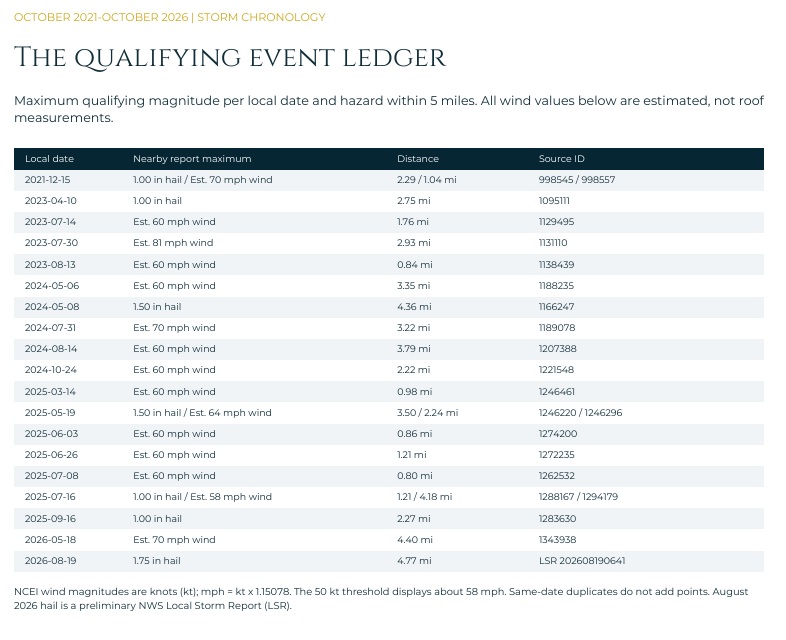
A residential evidence example connecting property history, nearby weather records, and the questions that still need field verification. Customer names and exact property addresses are removed from the public example.
Crown’s 2027 evidence initiative · not a new law or filing deadline
Kansas City residential review
A loss needs a traceable record.
Policyholders need to substantiate the loss they report. Crown’s construction documentation connects physical observations, the reported timeline and relevant public weather records, then identifies what still needs verification.
Open full image ↗Actual report excerpt · original PDF p. 4. Public copy omits customer identifiers.
01 / The building
Document the physical evidence.
Dated photographs, marked evaluation areas, material identification and comparisons between relevant surfaces.
02 / The chronology
Connect the reported loss date.
Owner observations, earlier records, repair history and public weather reports. Retain event IDs, distances, time zones and source limitations.
03 / The explanation
Test competing causes.
Evaluate weather alongside aging, installation, mechanical effects and previous repairs. Resolve conflicts instead of selecting only supportive evidence.
04 / The scope
Show what restoration requires.
Tie each proposed operation to the observed condition, access constraints, material compatibility and repairability findings.
Weather corroborates. The property supplies the physical evidence.
A nearby storm report does not establish that a specific roof was damaged on that date. Preliminary Local Storm Reports can be revised. Preserve the reported loss chronology and explain uncertainty; do not choose a date just because it matches a storm.
Crown documents construction conditions and repair recommendations. The report does not determine policy coverage, guarantee payment or establish a loss date from weather alone.
01Will my insurance company really approve a brand new roof?
Approval depends on the cause and extent of damage and your policy’s coverage, exclusions and roof settlement terms. A storm nearby does not automatically qualify a roof for replacement. Ordinary wear and tear is generally excluded.
Crown can document visible conditions, photographs, measurements and the construction work recommended. Your insurer decides coverage and payment. Report a suspected loss promptly and ask your insurer about the deadlines and responsibilities in your policy.
02Can my insurance company drop me or raise my rates if I file a claim?
There is no single answer for every homeowner. Rates and renewal decisions depend on the insurer, loss history and applicable state rules, including any storm-related protections.
Ask your insurance agent or company how a claim may affect your policy. Your state insurance department can explain consumer protections or review a complaint. Crown cannot promise that a claim will have no effect on your premium or renewal.
03Why am I the only person on the block that didn’t get a new roof?
Nearby homes can have different damage, roof conditions and insurance coverage. A neighbor’s replacement does not determine the outcome for your roof.
Ask your insurer for its written explanation. Crown can provide dated photographs and construction findings for you to compare with the stated repair scope. A review may identify questions that need clarification; it does not guarantee a different claim decision.
A useful price starts with your roof’s size, pitch, materials and access, then accounts for decking, flashing, ventilation, removal and installation. Crown confirms the scope and price in a written proposal.
For an insurance-funded project, your deductible may be only part of your expense. Noncovered work, upgrades and depreciation that your policy does not reimburse can add to your cost. Ask about current payment or financing options; availability, approval and terms must be confirmed in writing.
05Is there a legal way to avoid paying my deductible?
Plan to pay the deductible required by your policy. Do not rely on a promise to hide it in an inflated invoice or misstate the amount paid. Project invoices and payment records should accurately reflect the work and actual charges.
If the upfront cost is a concern, ask Crown about current payment options and confirm any financing terms before committing. Financing can spread payments over time; it does not remove your deductible obligation.
Start with your property, your reported loss timeline and the documentation you already have. Crown will confirm the next inspection or records review, scope and any fee.
This request does not confirm an appointment or purchase.
Start your request
Tell Crown about your property and choose an email reply or personal phone call.
A $20,000 Roof. A Potential $10,000 Funding Difference.
See the 15-year-old roof example: a $5,000 deductible can leave the owner funding $5,000 under qualifying RCV terms or $15,000 under the illustrative ACV calculation.
Send your property or report request before the meeting so Crown can prepare. Check the calendar’s time zone. Crown confirms the location for in-person reviews. Booking a review does not schedule inspection or installation work. Privacy