Photographs with context. Calculations you can follow. Sources you can open. Crown’s framework makes the path from an observation to a recommendation visible.
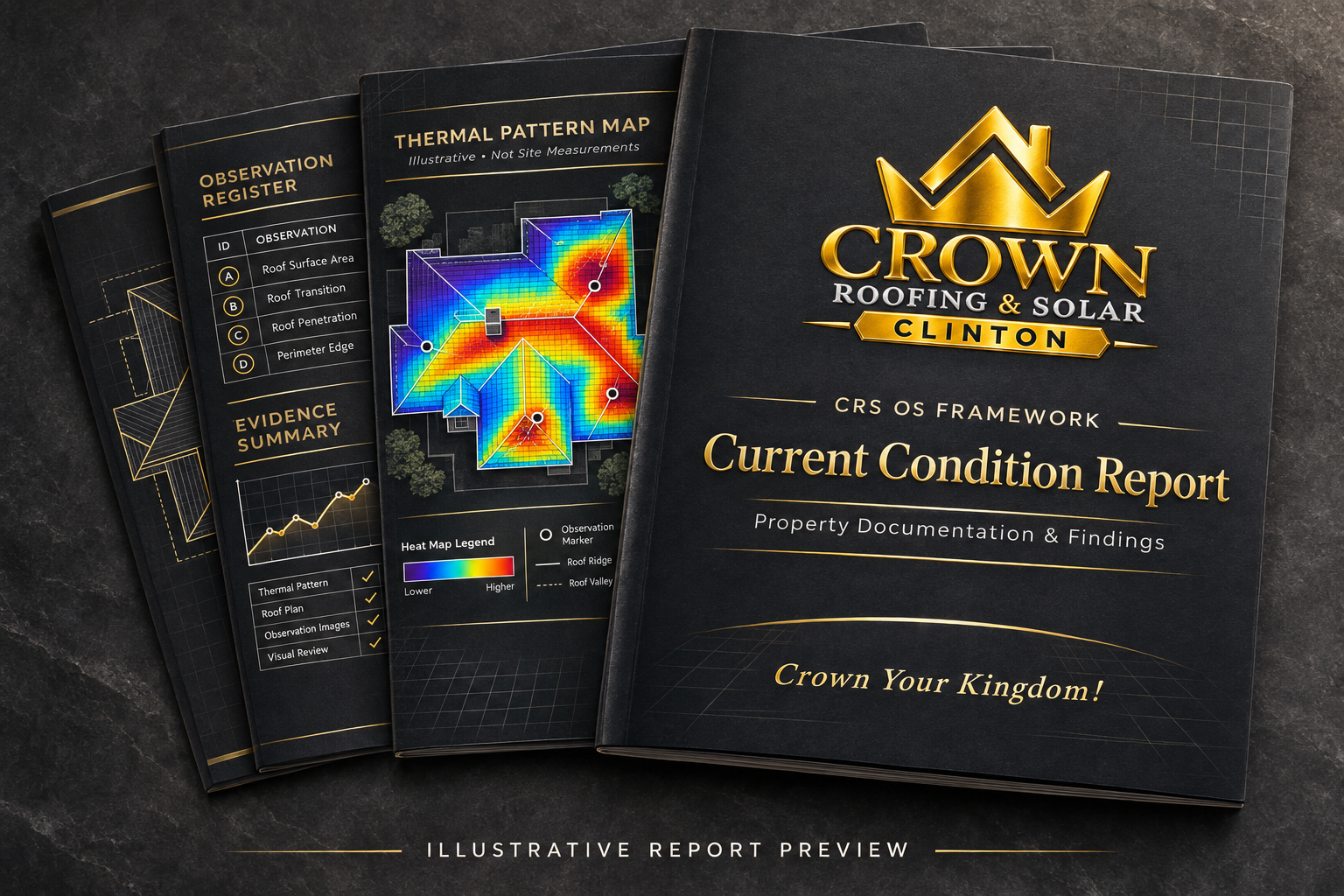
Current Condition ReportIllustrative report preview. Heat map and charts are not site measurements.Enlarge Preview ↗
Two Property Types. Distinct Case Studies.
The Right Example For Your Property.
Commercial / Industrial
Building Systems. Documented Scope.
The City of Holden metal-roof project and a redacted commercial condition report show two different situations: a construction scope and an existing-condition investigation.
Each class answers a different question. A useful report preserves those distinctions all the way through the recommendation.
01
Observed
A visible condition
The original photograph, inspection date, location on the building and the limits of the view.
02
Recorded
A dated source
Maintenance records, equipment labels, public weather records and the source each statement relies on.
03
Modeled
An estimate with inputs
Solar potential, calculated capacity and explicit assumptions. A model remains distinct from a field measurement.
04
To verify
An open question
Missing dates, uncertain causes, concealed components and the test or record needed to resolve them.
See A Dated Clinton Field Observation
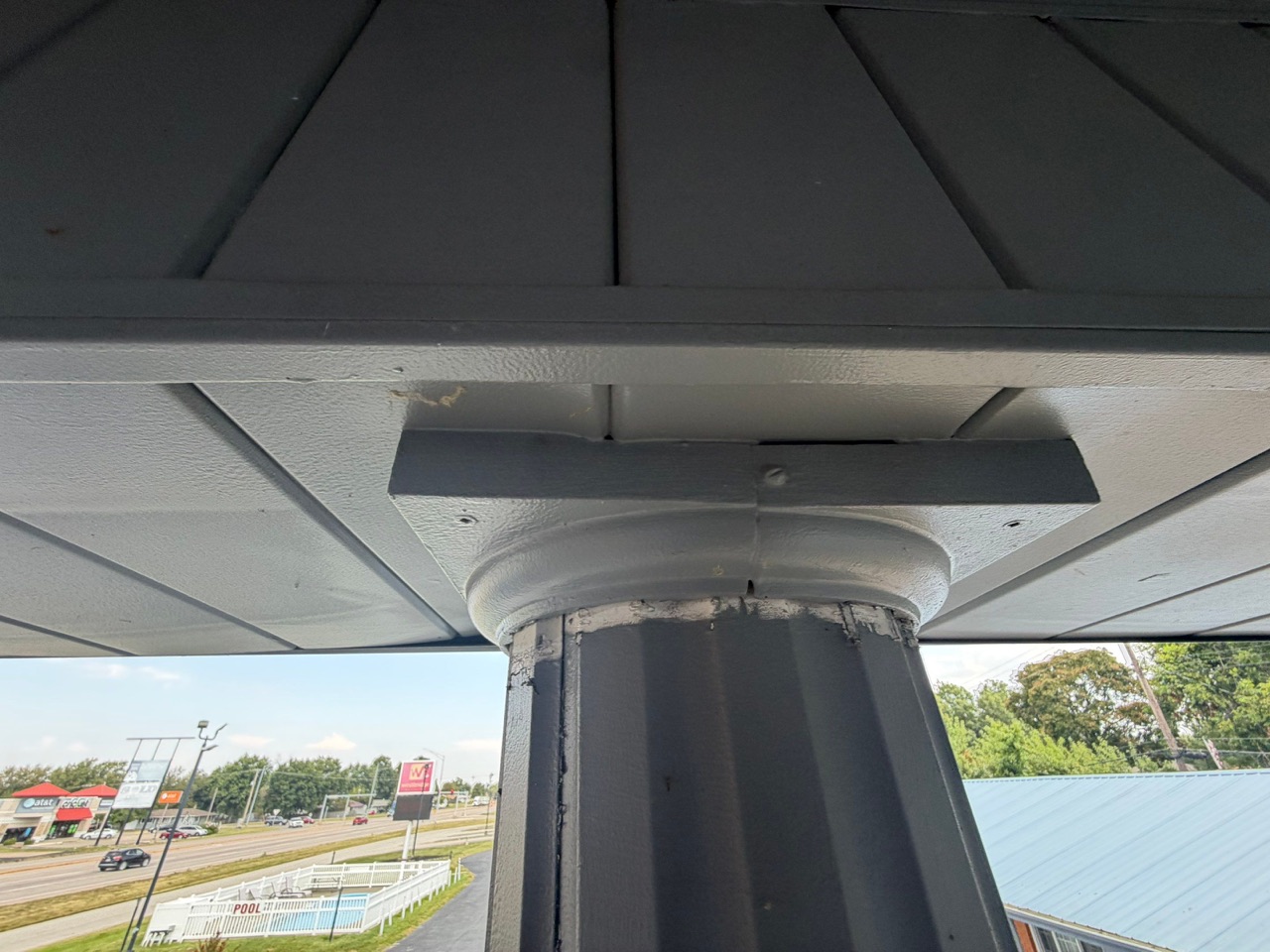
FIELD NOTE / CLINTON, MO
2026.09.09Original capture date + city verified from source metadata
Condition documentation · exterior connection Observation is the starting point. Cause requires more evidence.
02 / From a real report · Kansas City residential review
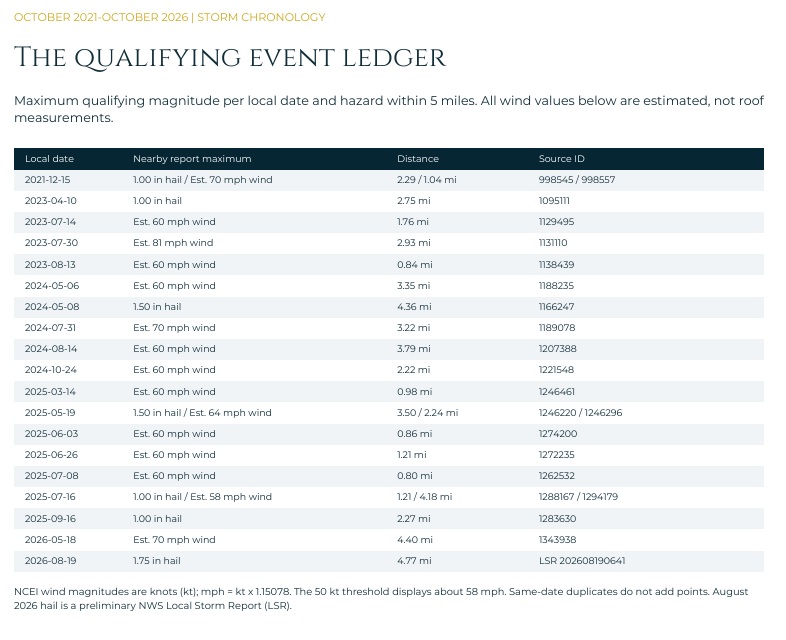
A chronology you can interrogate.
This chart transcribes the 19 qualifying dates in the report’s event ledger. Each hazard is shown separately, with the original event IDs retained below.
NEARBY REPORTED WEATHERReport window: October 2021–October 2026 · within 5 miles of the reviewed property
2021-12-15
1 in
2023-04-10
1 in
2024-05-08
1.5 in
2025-05-19
1.5 in
2025-07-16
1 in
2025-09-16
1 in
2026-08-19
1.75 in
Hail diameter in inches. August 19, 2026 is a preliminary Local Storm Report in the source packet.
These historical values are reproduced from the Crown report, not independently revalidated here. Nearby weather is context; it does not prove impact or damage at the roof. Missing values mean no qualifying value in this ledger, not zero weather.
Read the event values and source IDs
Kansas City residential report, original PDF page 4 · one maximum per local date and hazard
Adapted from the Kansas City residential review and Commercial Property methodology: document comparable areas, test competing explanations, and retain the gaps.
Define the question
Condition today, a specific performance issue, repairability or a preliminary weather review. Agree on what the work can answer.
Preserve the record
Keep originals. Record available capture dates, photo IDs and the location on the building. Distinguish capture time from an upload date.
Compare like with like
Match material, age, slope and exposure where possible. Document both exposed and sheltered areas, measurements and close-ups.
Test alternatives
Consider wear, installation, prior repairs, mechanical effects and weather. A mark alone does not establish its cause or date.
State the limit
Identify concealed areas, missing records and further qualified testing. Tie each recommendation to the evidence that supports it.
04 / Calculations with units
Show the inputs. Keep the assumptions.
Two simple examples of a calculation trail. Neither is a substitute for property-specific measurements or a final design.
Weather unit conversion
The source ledger rounds its 50-knot threshold to about 58 mph. Converting units does not turn an estimated report into a roof measurement.
Solar nameplate capacity
DC nameplate capacity is distinct from AC inverter rating, annual kWh production and utility approval. Use the property lookup for a modeled roof-specific starting point.
A dated chronology connects nearby reported weather, distance and source IDs. Estimated wind remains labeled as estimated. The ledger does not establish damage at the property.
Original PDF page 4 · customer identifiers and private links omitted
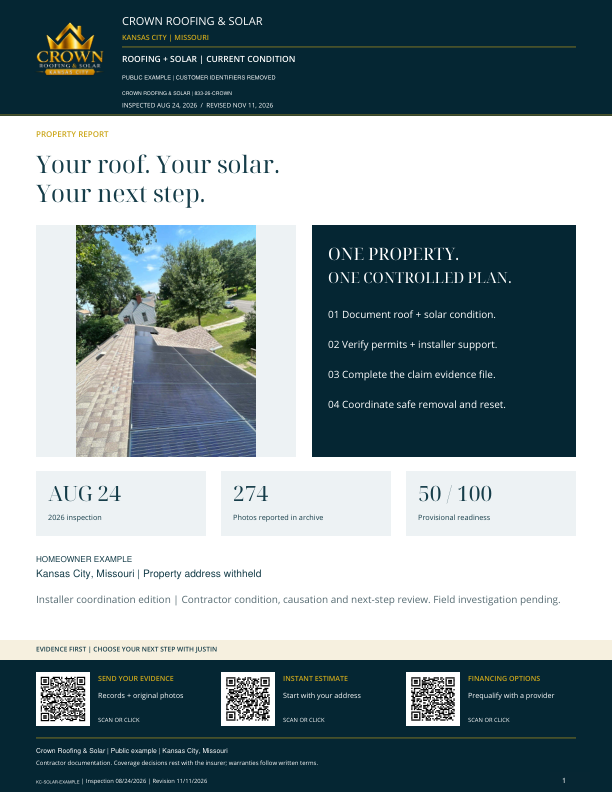
Follow the complete technical investigation: dated imagery, roof-age analysis, permit history, quantity and funding calculations, solar diagnostics, field photographs, detach/reset controls, and the revised sign-off form.
Complete public example · All 44 pages · customer identifiers and private links omitted
03 / Commercial Property · Clinton commercial review
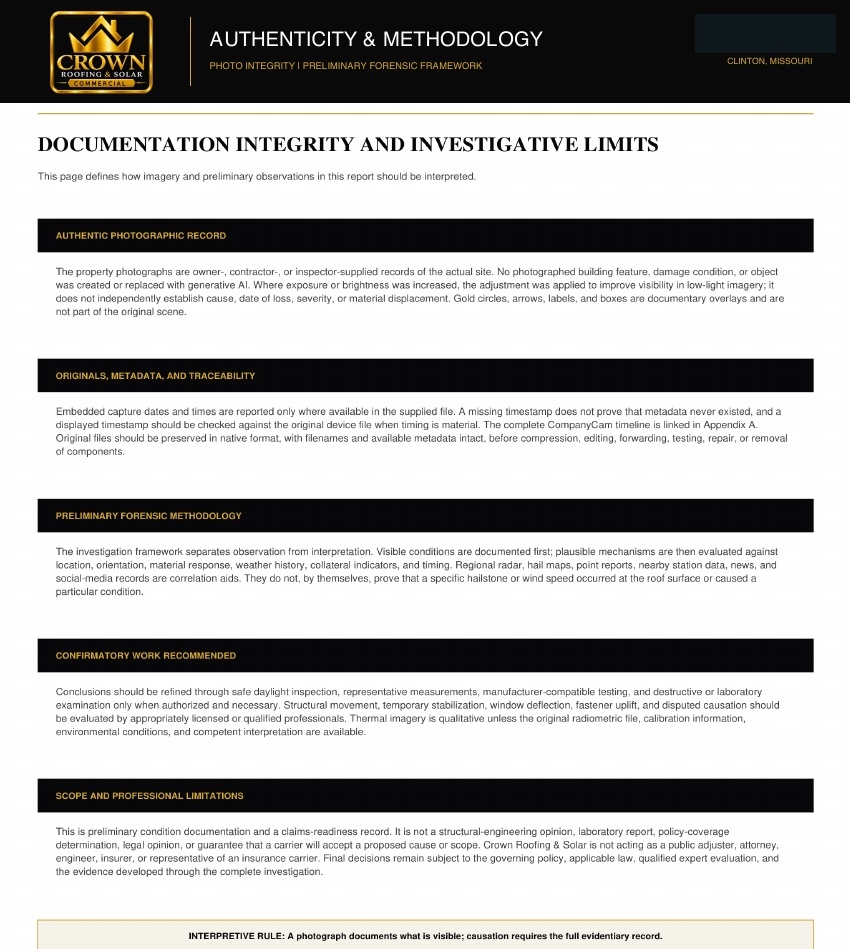
The limits belong in the record
An explicit methodology separates photographs, observations and interpretation. Missing metadata, qualitative thermal imagery and unverified causes are identified rather than filled in.
Original PDF page 26 · customer identifiers and private links omitted
Reference desk / scan or click
Every reference. A way back to the source.
Public source methods sit beside the record. Private photographs, customer files and owner-only links stay in your private Project Portal.
QR codes and their surrounding cards open the same public resource. The original source-page numbers accompany each report excerpt.
Crown provides contractor observations and construction recommendations. This framework is not a licensed engineering opinion, laboratory result, coverage determination or guarantee of causation.
Your property / the next chapter
A clear record starts with a closer look.
Bring the roof, solar system and property history into one organized file. Crown will confirm the scope, available records and the right next step with you.
Prefer to begin without a meeting? Send a report request. Crown confirms any fee and appointment separately.
Crown / 2027 evidence initiative
Prove It or Lose It in 2027!
Document the damage. Corroborate the timeline. Support the repair scope.
A compelling claim starts with a documented loss. Connect the conditions on the building to the reported event, the available records and the work needed to restore the affected materials.
The goal: a clear chain from observation to explanation to proposed scope—one that another reviewer can follow.
Build my evidence record↗Evidence supports a claim; policy terms and the insurer’s review determine coverage. “2027” identifies this Crown campaign, not a new law or filing deadline.
Evidence Intake
Have Records? Start Building The Picture.
See what to preserve, how Crown connects the evidence and why a dated baseline matters before your next roof decision.
Explore a real Crown case through State Farm’s dated estimate revisions, newly included siding and abatement scope, and the projected work still ahead.
A useful warning window. A question to resolve before a loss.
Roof age can affect replacement-cost eligibility and depreciation. At renewal, ask your agent to confirm your roof settlement terms in writing. At the property, establish a dated condition record.
ESTABLISH
Your Baseline
Installation date, materials, photographs and repair history.
10–15 YEARS
Review Before Renewal
Confirm roof age, condition, settlement method and any endorsement changes.
KEEP CURRENT
Your Property Record
Document changes after storms, repairs and planned work—even when no storm damage is found.
“Cliff” describes a potential funding change, not an automatic age-10 conversion or a universal deadline. Actual terms vary by insurer, state, material, endorsements and renewal. A condition report does not preserve or change insurance coverage.
Farm Bureau Financial Services
Directly Addresses Ages 10–15
Its comparison describes other insurers’ treatment of roofs in this range as Frequently shifted to ACV during this period. Its own replacement-cost availability can extend through age 15 and beyond under qualifying loyalty terms.
Its roof-coverage page describes ACV in the base policy and optional replacement-cost coverage for eligible roofs. The insurer identifies roof age and type as eligibility factors; availability and terms vary by state.
Travelers explains depreciation using replacement cost and expected life, while also considering condition. It distinguishes an initial ACV payment from potential additional reimbursement after qualifying repairs.
A $20,000 replacement. A 15-year-old composition roof described as a 30-year product. A $5,000 deductible.
For this example only, assume a 30-year depreciable life and straight-line depreciation: 15 ÷ 30 = 50%, or $10,000. A product’s rating does not establish its actual useful life or the insurer’s depreciation schedule.
Final Funding / $20,000 Total In Both Cases
Replacement Cost / RCV
$15,000$5,000
Actual Cash Value / ACV
$5,000$15,000
Insurer PaymentOwner Funded
RCV: $5,000 initial net payment + $10,000 recoverable depreciation after requirements are met = $15,000 final net. ACV: $5,000 final net, with no recovery of this example’s depreciation.
Examine The Calculation & Assumptions
Illustrative covered replacement; same accepted $20,000 scope and deductible
Item
RCV
ACV
Replacement Cost
$20,000
$20,000
Assumed Depreciation: 15 ÷ 30 × $20,000
$10,000
$10,000
Deductible
$5,000
$5,000
Initial Net Payment
$5,000
$5,000
Recoverable Depreciation After Conditions Met
$10,000
$0
Final Net Insurer Payment
$15,000
$5,000
Owner-Funded Total
$5,000
$15,000
This illustration assumes a covered loss, sufficient limits, no other exclusions or payment reductions, completion of the accepted $20,000 scope, and satisfaction of all RCV recovery requirements. Actual age, condition, depreciation methods, deadlines and deductible provisions vary. It is not a quote or payment prediction.
Ask your agent: Is my roof covered at RCV, ACV or a payment schedule? Is depreciation recoverable? What changed at renewal? Which wind/hail deductible and completion requirements apply?
For Owners Who Want The Facts
Know The Condition. Keep The Evidence.
The Crown OS record captures facts at a specific date and time. A sound roof deserves documentation too. Begin with a Current Condition Report; use a Claim-Readiness Review when a reported event needs investigation.
Insurer sources reviewed November 11, 2026. They explain their own programs and methods; they do not establish the terms of a particular Missouri or Kansas policy. Crown provides condition and construction documentation, not insurance-policy interpretation.
Your Questions. Time With Crown.
Book A Property Or Report Review.
Talk through your roof, report findings, repair questions or proposal. Choose a video meeting or an in-person review.
Send your property or report request before the meeting so Crown can prepare. Check the calendar’s time zone. Crown confirms the location for in-person reviews. Booking a review does not schedule inspection or installation work. Privacy
Actual Records. A Clear Next Step.
See What Crown Delivers.
Choose the example that matches your property and the decision ahead. Then book time to discuss your own evidence and project.
Read The Evidence · PDF Example
Current Condition Report
An actual commercial inspection excerpt: photographs, observed conditions, and the next qualified review. Customer names and exact property addresses are removed from the public example.
A residential evidence example connecting property history, nearby weather records, and the questions that still need field verification. Customer names and exact property addresses are removed from the public example.
Real roof and solar evidence showing why access, materials, and connected assemblies belong in a repair plan. Customer names and exact property addresses are removed from the public example.
The complete Kansas City report: historical imagery, roof-age analysis, equipment verification, monitoring, diagnostics, detach/reset controls, and the revised sign-off form. Customer names and exact property addresses are removed from the public example.
Follow the municipal metal-roof record from the first carrier scope to Crown’s final documented scope. Customer names and exact property addresses are removed from the public example.
Follow the dated estimate revisions and construction documentation for a specialty residential project. Customer names and exact property addresses are removed from the public example.